| Whitefly in Cotton

- In India, whitefly
was first recorded on cotton at Pusa (Bihar) during 1905 and assumed
the status of a serious pest on cotton in Punjab in the 1930s
- Major outbreaks of
whitefly were noticed in different cotton growing states in India
namely undivided Punjab (1930-43), Andhra Pradesh (1984-87), Tamil
Nadu, Maharashtra and Karnataka (1985-87), Gujarat (1986-87) and
Punjab (1996)
- The introduction of
synthetic pyrethroids (insecticides) in cotton to control bollworms
in early 1980s favoured whitefly multiplication. So it was recommended
that pyrethroids should not be used for more than two sprays on
desi cotton (arboreum) and more than three sprays
on American cotton (hirsutum)
- Economic threshold level (ETL) of whitefly (6-8 adults per
leaf in the upper canopy of plant before 10.00 a.m.) was established
for application of insecticides for the management of this pest
- Over the years, whitefly
has created a niche in agroecosystem and has almost become a pest
of regular occurrence in all the cotton growing areas of North-West
India
Activity
period: May to October
Peak activity period: July to
September
Distribution in State
- Whitefly is distributed throughout the northern and western regions of
the Indian sub continent and it is very serious pests of American cotton,
particularly in dry areas
- In Punjab it occurs frequently in the districts of Bathinda, Fazilka,
Mansa, Sri Muktsar Sahib, Faridkot, Sangrur, Barnala and Moga in cotton and
other host plants
- Khuhian Sarwar block of Fazilka is generally considered to
be the hot spot for whitefly. The whitefly generally observed first in certain
pockets of district Fazilka like Khuhian Sarwar, Abohar and Fazilka and
spreads further to adjoining regions under favourable weather conditions
- However, moderate incidence of whitefly is recorded in districts like
Barnala, Moga, Sangrur and Faridkot
Important Host
plants of Whitefly in Punjab
It is a polyphagous pest and feeds on about 600
plant species throughout world.
Field crops:
Cotton, moong, mash, soybean, arhar, guar, sarson, toria
Vegetable crops:
Brinjal, cucurbits (pumpkin, toria, melon, summer squash),
okra, chilli, potato tomato, raddish, cabbage, cauliflower
etc.
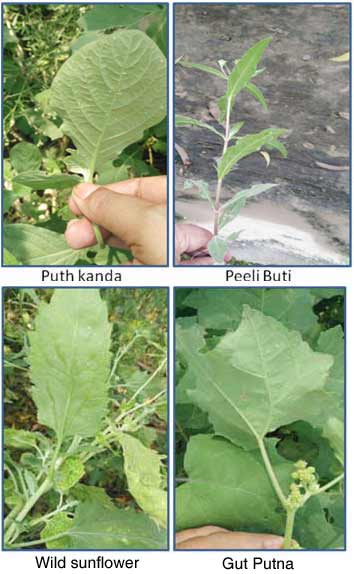
Weed host plants:
Peeli buti (Abutilon spp), Kangi buti (Sida
spp), Puth kanda (Achyranthes splendens), Button
buti, Makoh, Wild sunflower, Dhatura, Gut putna etc. |
|
Nature of damage
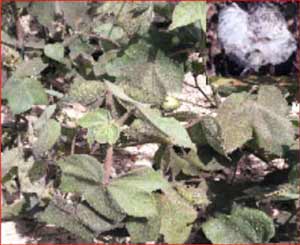
- Both nymphs and adult suck the plant sap by feeding on the undersurface
of leaves
- Chloratic spots develop on leaves which drop prematurely. It also cause
stunting of plants, shedding of fruiting bodies, bad boll opening
and poor quality lint and overall decline in seed cotton yield
- Nymphs and adults also excrete sugary liquid called 'honeydew' on which
sooty mold (black fungus) grows. The presence of sooty mold on
leaves interferes with photosynthesis and affects the overall
health and growth of the plant as well as lint quality
- The attack of whitefly gives the plant a sickly appearance
- Whitefly transmits cotton leaf curl virus and the infected
plants exhibit leaf curling, crumpling, vein thickening, cupping
and plant stunting etc. causing considerable yield loss
Natural enemies of Insect Pests of Cotton 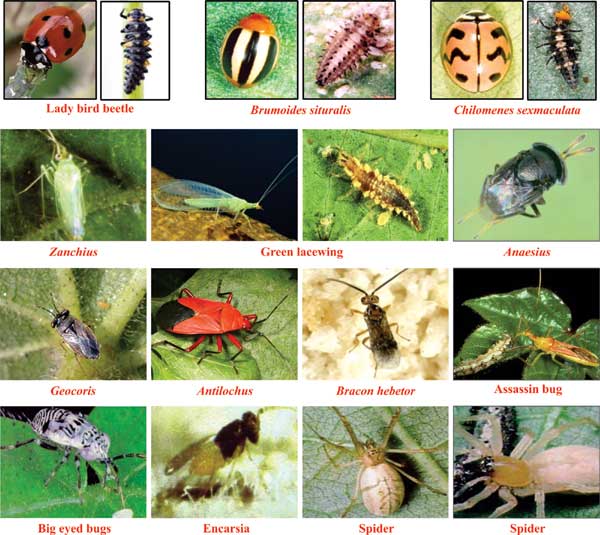
Besides spiders which catch large numbers of adult whiteflies
in their webs, there are eight species of natural enemies (five
of predators and three of parasitoids).
- The predatory beetles are Serangium parcesetosum Sicard, Brumoides suturalis (Fab.),
Cheilomenes sexmaculata
(Fab.), Coccinella septempunctata L. and a neuropteran, Chrysoperla
zastrowi sillemi (Esben-Petersen)
- The three parasitoids are Encarsia lutea
(Masi), Encarsia sophia (Girault & Dodd) and Eretmocerus
sp
|
|

